| AKA my Gentleman's Touring Contraption. |
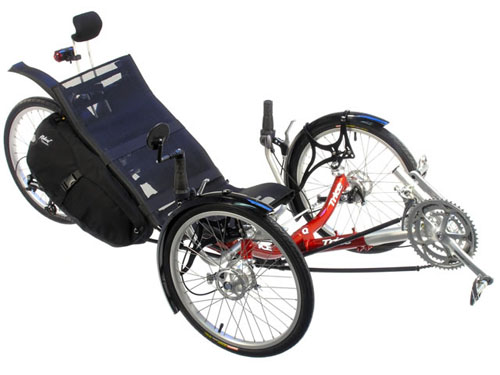
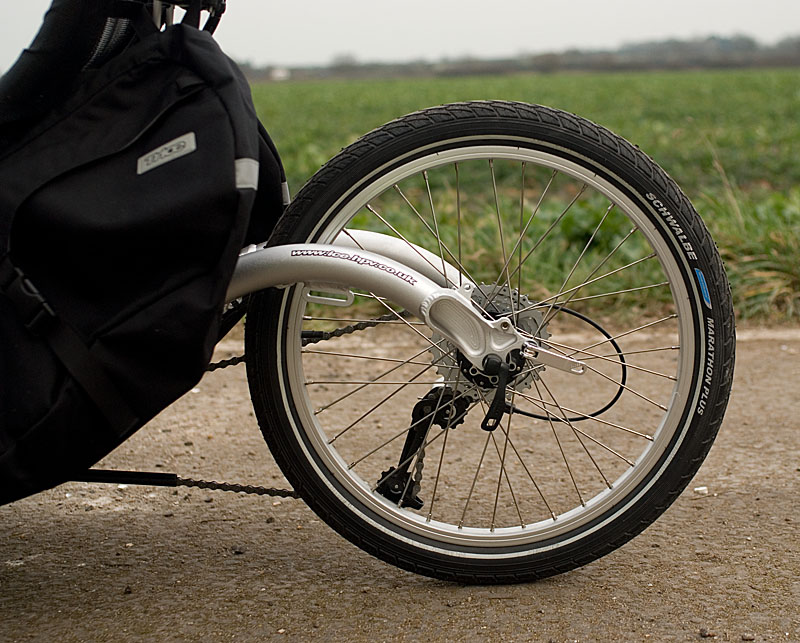
You can read about why I ride a recumbent trike here. I test-rode seven different trikes, and the TRICE Q just felt right. Made in Britain by Inspired Cycle Engineering, they epitomise the idea that efficient engineering is usually beautiful engineering. |
|
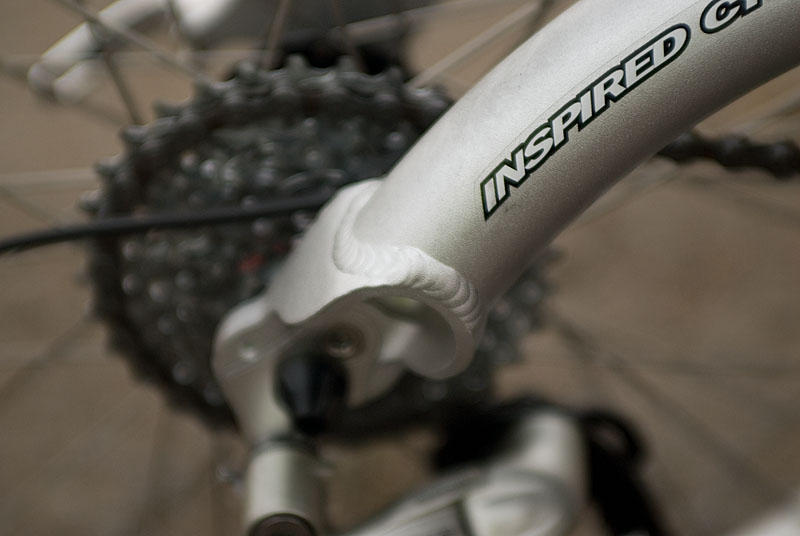
The quality of the workmanship is fantastic: |
It's worth being aware that ICE are the BMW of the trike world: the price-tag you see in the showroom bears very little relation to the final total you'll pay by the time you've added even a modest number of options. Even something as simple as a mount for a front light is an option! While the base price is £1800, I now have about three grand invested in mine. This sounds like a huge sum for a bicycle, but it really is that good. It's the last bike I ever expect to buy, so the cost per mile is really quite reasonable. The options I went for are ... Gears I've been through a few iterations of gears. The 2008 model I bought came with 26/36/48 front rings and an 11-32 rear cassette, giving a gear range of 15-85 inches. I wanted more top-end speed, so originally swapped the front rings for 30/48/60 (the latter a hard-to-find ring which we eventually found from HP), giving me 18-106 inches. However, ICE then brought out a new rear cassette, with a greater range of 9-34. This wasn't compatible with my big ring, so I upgraded to the new cassette and swapped the front rings to 30/42/52, which gives me 17-112 inches. :-) Quick-release kit
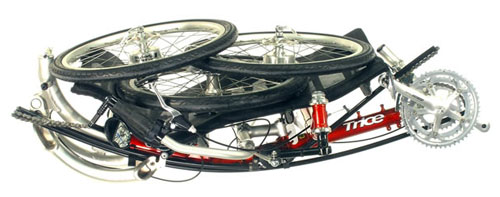
Trikes are not as easily transported as conventional bikes. Although you can get bike-racks to carry them, most of these are towball-mounted, which isn't an option with an SLK. Most trains also don't allow trikes to be carried (though I've had no problems on local commuter services with double doors). The trike can be reduced to something that will just about fit into a conventional bike-bag. The quick-release kit enables you to do this in about 15 minutes (yeah, I know the ICE website shows them doing it in just over two minutes, but they've had a bit of practice ...). Most importantly, once it's in a bag, it is no longer a trike for train company purposes: it is now merely a piece of luggage. Side pod bags A very clever pair of panniers that mounts to the trike without the need for a rack:
A set of straps go around the seat, and that's it. By eliminating the need for a frame, the weight is kept to a minimum. The position of the bags also means that the contents are accessible from the seat, which is handy for things like taking a photo or grabbing a snack. Each bag holds 12.5 litres; a total capacity of 25 litres is good enough for a weekend away if you're not camping. Streamer fairing |
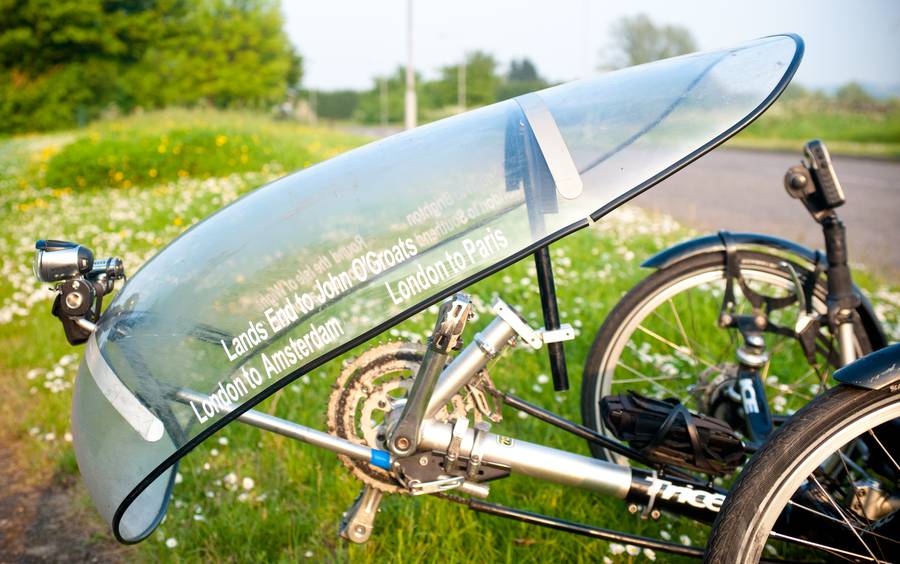
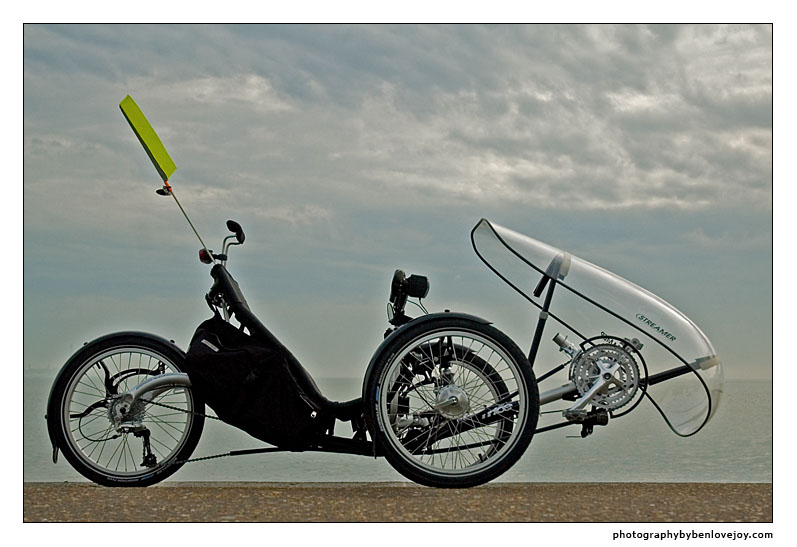
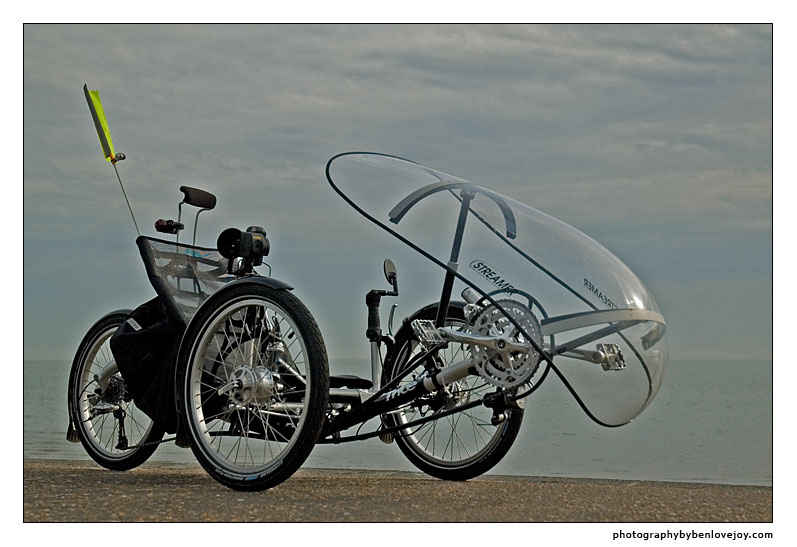
The Streamer is a perspex front fairing unit made by HP Velotechnik (manufacturers of the Scorpion trike). They're a great concept, but the mounting system is rubbish. No matter how tightly you fasten everything, the design means that the fairing slips forward and down. After trying a couple of variations on the theme, I eventually commissioned a local light engineering company to make custom mounts for it. At the front, the straight post of the original is replaced by a Y-shaped post to lift the front to a sensible height. The reason for this is that the clearance needed by my size 11 feet meant having the fairing at a steep angle, which left the rear of it in the middle of my field of vision. Raising the font allowed me to lower the rear. The second pole is supported by a hinged bracket that attaches to the front light-post of the Trice: |
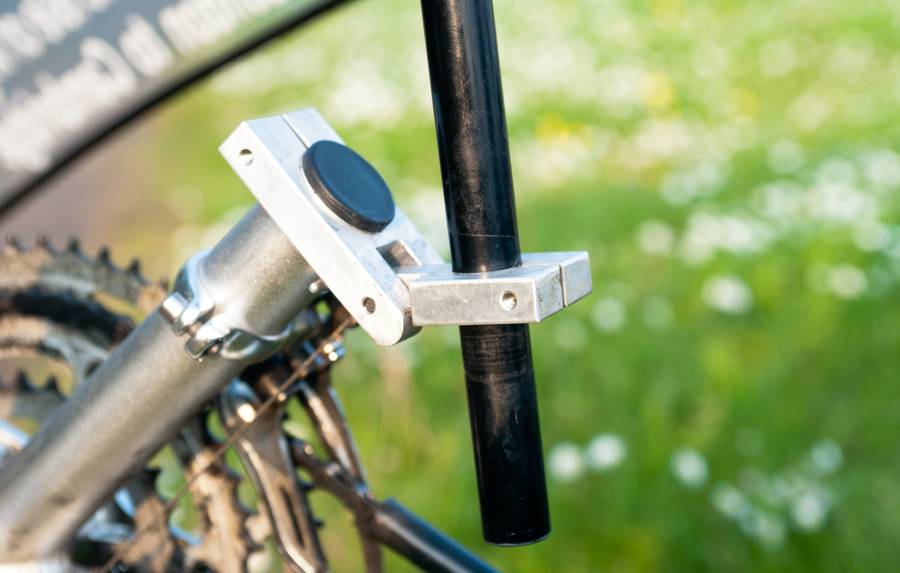
This is lighter and neater than the original, doesn't slip down and is easier to get in & out of (and yes, I do need to get around to cutting off the excess pole!). Of course, fitting a fairing then makes front-light fitment tricky, so some creativity was required there - detailed on ther lights page. Schwalbe Marathon Plus tyres |
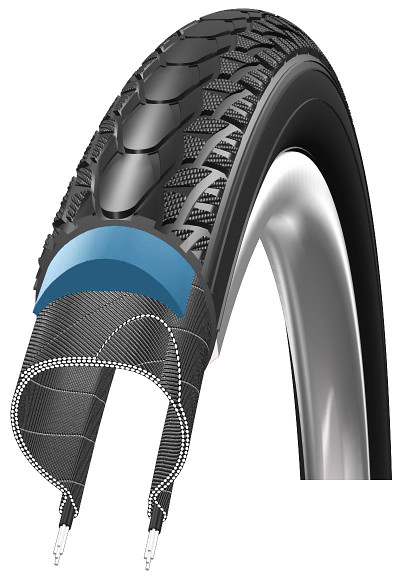
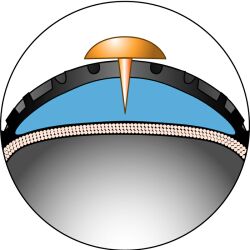
I hate p*nct*r*s. Most of the protective measures around (harder compounds, tape linings, etc) are of limited value, but Marathon Plus tyres really work. They have a special rubber barrier layer between tyre rubber and lining that is designed to catch any objects before they can reach the lining. TANSTAAFL, of course, and the barrier layer does add 200g per tyre, so an all-up unsprung weight penalty of 600g. But this, in my view, is a small price to pay. I've done 4000 miles on them with only one ... you know, the P-word ... which was a nail which somehow got flipped into an upright position. Parking brake |
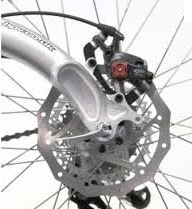
Unlike a two-wheel bike, a trike will roll away if parked on a slope or caught by a gust of wind. The standard TRICE comes with velcro straps to fasten around one or both of the front brakes, but these gradually lose their stickiness over time and are in any case a clunky solution. I bought the parking brake, which is a disk-brake that fits to the rear wheel. Although it can be used with caution as a drag-brake, it is really designed to be used as a handbrake when parked. It's also nice to be able to sit at traffic lights on a slope without having to hold on the brakes. Trivia Mudguards, neck-rest, front light mount, second mirror, Space Grip (for the GPS). |
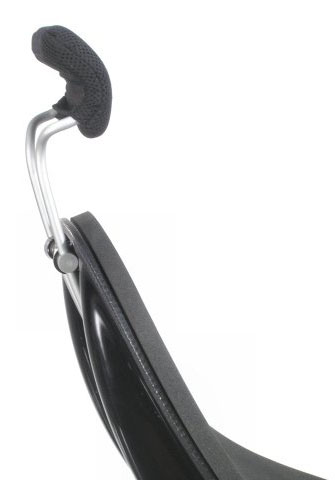
I found the headrest material a bit uncomfortable, and the padding tended to wander a bit, so friends who run a leather repair business made a replacement for me to fit over the existing metal frame: |
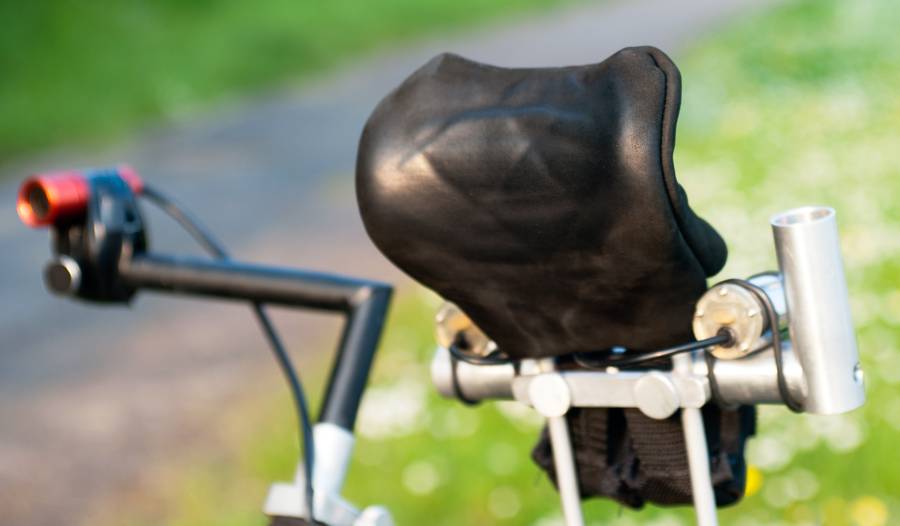
You'll also notice the bulletcam in this photo - detailed on the camcorder page. |
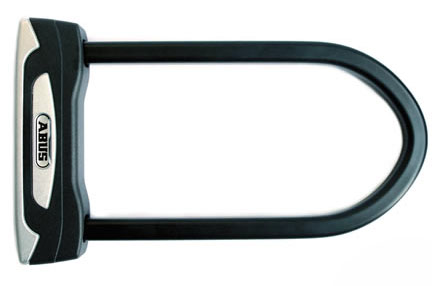
One piece of kit you definitely don't want to skimp on is the lock. The bad news is there is no lock in the world that will defeat someone who (a) knows what they are doing and (b) really, really wants your bike. The good news is that locks generally don't have to do this. Usually what's required is to make your bike sufficiently hard to steal that they'll go for an easier target. The job of a decent lock, then, is to make it awkward, noisy and time-consuming to steal your bike. The highest standard of lock is known as Sold Secure Gold. This means it successfully survived a sustained attack using all tools commonly used by bike thieves, including both bolt-croppers and a portable angle-grinder, for a full five minutes. There are vanishingly few situations where a thief will be willing to make that much noise for that length of time. The bad news is that secure means heavy. Cable-locks are nice and light but even the toughest of them can be cut using extremely small croppers in less than a second. The only Sold Secure Gold locks are thick chains with heavy padlocks, and heavy D-locks. My own choice is the Abus Granit X-plus 54. 13mm square hardened steel shackle, shaped to resist twisting attacks, and a double-locking system so that a thief would have to cut through the shackle on both sides in order to remove it. |
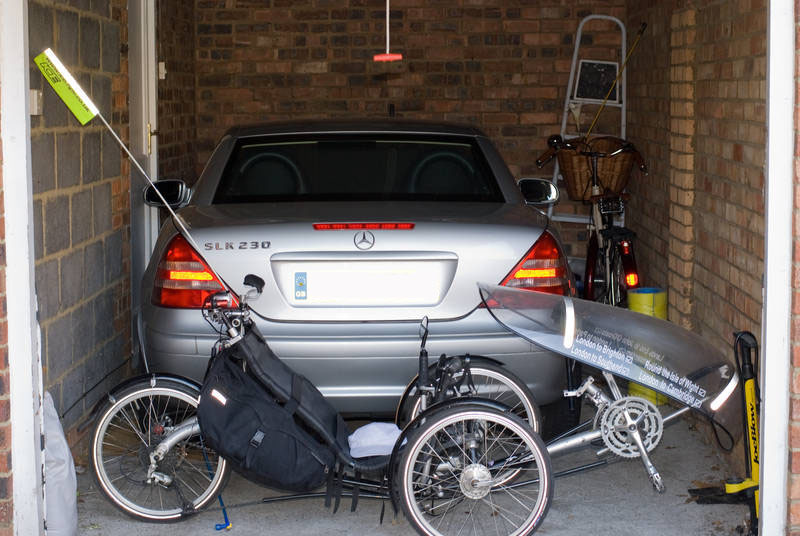
People sometimes worry about storing a trike, but mine started out life stood up on its (chocked) rear wheel leaning against the hall wall. I subsequently had a bit of a rejig of my rather compact garage, and it now comfortably stores an SLK and a TRICE, with room to spare. |